
IntelVA Insights
Why logistics operations are struggling today
& how AI is redefining the game
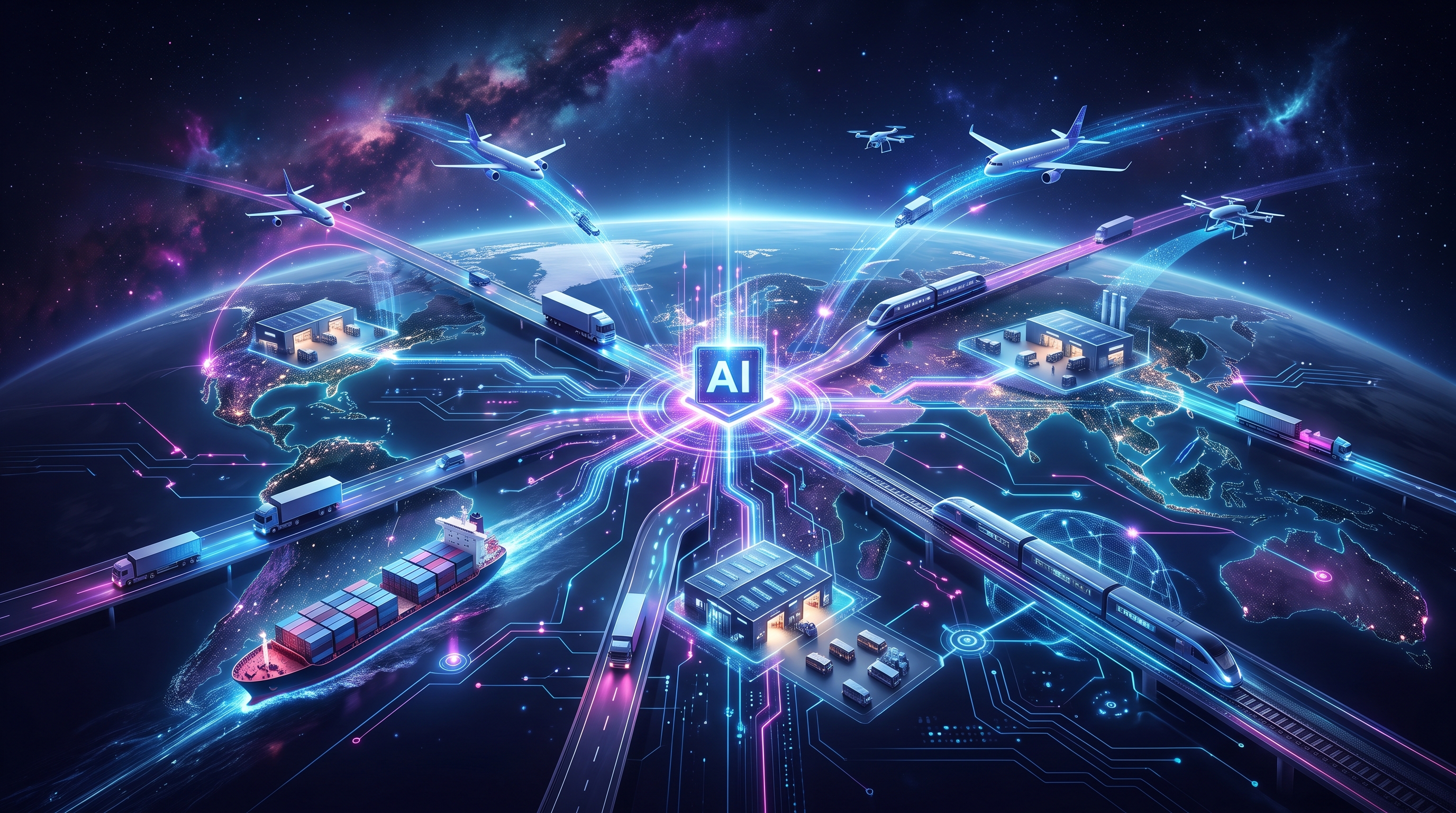
For decades, logistics has operated quietly in the background, acting as the backbone of global commerce. Goods are transported, orders are fulfilled, deliveries are completed, and when everything works as expected, it often goes unnoticed. But when something goes wrong, the impact is immediate and visible. Delays cascade across supply chains. Costs rise unpredictably. Customer expectations are missed. Margins begin to shrink. What was once considered a stable operational function has become a highly sensitive and complex system, where even small inefficiencies can produce significant consequences. What has changed is not the importance of logistics, but the environment in which it operates. Today’s logistics landscape is defined by rising demand, tighter delivery windows, increasing operational costs, and constantly evolving external conditions. At the same time, businesses are expected to maintain speed, accuracy, and transparency across every stage of the process. Yet many organizations are still relying on systems and workflows that were not designed for this level of complexity. And that is where the real challenge begins.
A System Under Constant Pressure
Modern logistics is no longer a linear chain of events. It is a dynamic ecosystem where decisions must be made continuously, often under uncertainty and tight time constraints. In many organizations, dispatching decisions still rely heavily on manual input. Routing strategies are based on static assumptions rather than real-time conditions. Delivery timelines lack precision and adaptability, while communication between systems and teams remains fragmented. Each of these issues, on its own, may seem manageable. But when combined, they create a network of inefficiencies that is difficult to control. A delay in dispatch leads to inefficient routing. Inefficient routing affects delivery timelines. Late deliveries erode customer satisfaction and operational credibility. Over time, these small disruptions accumulate into measurable financial loss and operational instability. What makes this particularly challenging is that these problems are rarely isolated. They are interconnected, and often rooted in a lack of visibility, coordination, and adaptability across the system.
The Limits of Traditional Logistics Systems
Traditional logistics systems were designed primarily to execute tasks and record outcomes. They provide essential information such as shipment tracking, delivery confirmation, and billing records. However, they were not built to interpret data or guide decisions. They can tell you what has happened, but not what is about to happen. This creates a critical gap between data availability and actionable insight. As a result, teams spend valuable time reacting to issues rather than preventing them, decisions are based on historical data instead of current realities, and inefficiencies remain hidden until they impact performance. In an increasingly competitive environment, this reactive approach is no longer sufficient.
From Execution to Intelligence
Artificial intelligence introduces a fundamental shift in how logistics operations are managed. Rather than functioning solely as support tools, AI-enabled systems can analyze patterns, detect anomalies, and assist in decision-making processes in real time. This represents a transition from reactive operations to proactive management, from static planning to continuous optimization, and from fragmented data to connected intelligence. AI does not replace human expertise. It enhances it. It provides decision-makers with deeper visibility, contextual understanding, and predictive insight at a scale that would otherwise be impossible to achieve manually.
Where AI Creates Tangible Impact
AI’s value becomes clear when we look at the operational bottlenecks logistics teams face every day. The strongest use cases are not theoretical. They are practical, measurable, and closely tied to cost, service quality, and control.
Smarter Dispatching
Dispatching is one of the most critical control points in logistics. Assigning the right resources at the right time requires balancing multiple variables simultaneously. AI supports stronger dispatch decisions by evaluating factors such as location, capacity, timing, and priority in real time. The
Dynamic Route Optimization
Traditional route planning often relies on predefined paths and assumptions that may not reflect current conditions. AI-driven routing systems adapt continuously based on real-time inputs such as traffic, delivery priorities, and operational constraints. This allows for more efficient routes, reduced travel time, and lower fuel consumption.
Accurate and Predictive ETA
Estimated time of arrival has historically been treated as an approximation. With AI, ETA becomes a dynamic and predictive metric. By analyzing both historical and real-time data, systems can generate more accurate delivery forecasts, improving transparency and customer satisfaction.
Early Detection of Financial Irregularities
In complex logistics environments, billing discrepancies and unexpected charges can easily go unnoticed. AI can analyze transaction patterns to detect anomalies, flag inconsistencies, and provide early warnings, helping organizations maintain tighter financial control.
Better Management of Hidden Costs
Many logistics expenses are not immediately visible. Additional charges, inefficiencies, and operational leakage can accumulate over time. AI helps identify those patterns and provides insight into where costs can be optimized without compromising service quality.
Real-Time Alerting and Monitoring
One of the biggest operational challenges is not always the issue itself. Often, it is the delay in identifying it. AI-powered alerting systems can detect disruptions as they occur and notify the right teams instantly, allowing faster response and mitigation.
Automation of Operational Communication
A significant portion of logistics coordination still depends on emails and manual updates. AI can process unstructured data, extract relevant information, and automatically update system statuses, reducing manual effort and minimizing the risk of human error.
Intelligent Operational Support
AI-powered assistants can help teams access relevant information quickly, answer operational questions, and support decision-making with greater consistency. This improves efficiency and reduces reliance on fragmented sources of information.
Performance Analysis Across the Network
Logistics performance is influenced by both internal operations and external partners. AI enables continuous evaluation across the network, helping organizations make more informed decisions regarding vendors, partners, and broader operational strategy.
Simulation and Scenario Planning
One of the more advanced applications of AI in logistics is the ability to simulate operational scenarios. By creating digital representations of logistics environments, organizations can test decisions before implementation, reducing risk and improving planning accuracy.
Driver Behavior Analysis
Human factors remain an important part of logistics operations. AI can analyze driving patterns to identify inefficiencies, safety risks, and opportunities for improvement, leading to both cost savings and safer operations.
From Cost Center to Strategic Advantage
When applied effectively, AI transforms logistics from a purely operational function into a strategic asset. Organizations benefit from improved efficiency and reduced operational costs, increased delivery reliability, enhanced visibility across operations, and faster, more informed decision-making. More importantly, logistics evolves from being viewed as a cost center to becoming a driver of performance and competitive advantage.
A Necessary Shift in Mindset
Adopting AI in logistics is not simply a technological upgrade. It requires a shift in how operations are approached. It means moving away from reactive workflows, disconnected systems, and static planning models, toward continuous optimization, integrated data environments, and proactive decision-making. This transformation allows organizations to manage complexity more effectively while maintaining stronger control over operations.
Looking Ahead
The future of logistics will not be defined solely by speed or scale. It will be defined by intelligence. Systems will increasingly learn from data continuously, adapt to changing conditions in real time, and support decisions with higher levels of accuracy. In this environment, the difference between average and high-performing logistics operations will not lie in infrastructure alone, but in the quality of intelligence guiding those operations.
Final Word
Logistics has always been complex. But today, that complexity has reached a point where traditional approaches are no longer sufficient. Artificial intelligence offers a new path forward, one where systems do more than execute tasks. They help interpret data, anticipate challenges, and optimize performance continuously. Organizations that embrace this evolution will not only address current challenges. They will position themselves to succeed in an increasingly demanding environment. Because in modern logistics, success is no longer defined by movement alone. It is defined by how intelligently that movement is managed.